30 September 2026
What is an AI agent — and how is it different from a chatbot?
Nikolay Kalchev · 30 September 2026
Most people have already talked to a chatbot: the window in the corner of a website that answers questions, or a tool like ChatGPT. So when someone says “AI agent”, it is easy to think it is the same thing with a new name. It isn’t. The difference is simple, and it matters for any business: a chatbot answers, an agent acts.
A chatbot answers questions
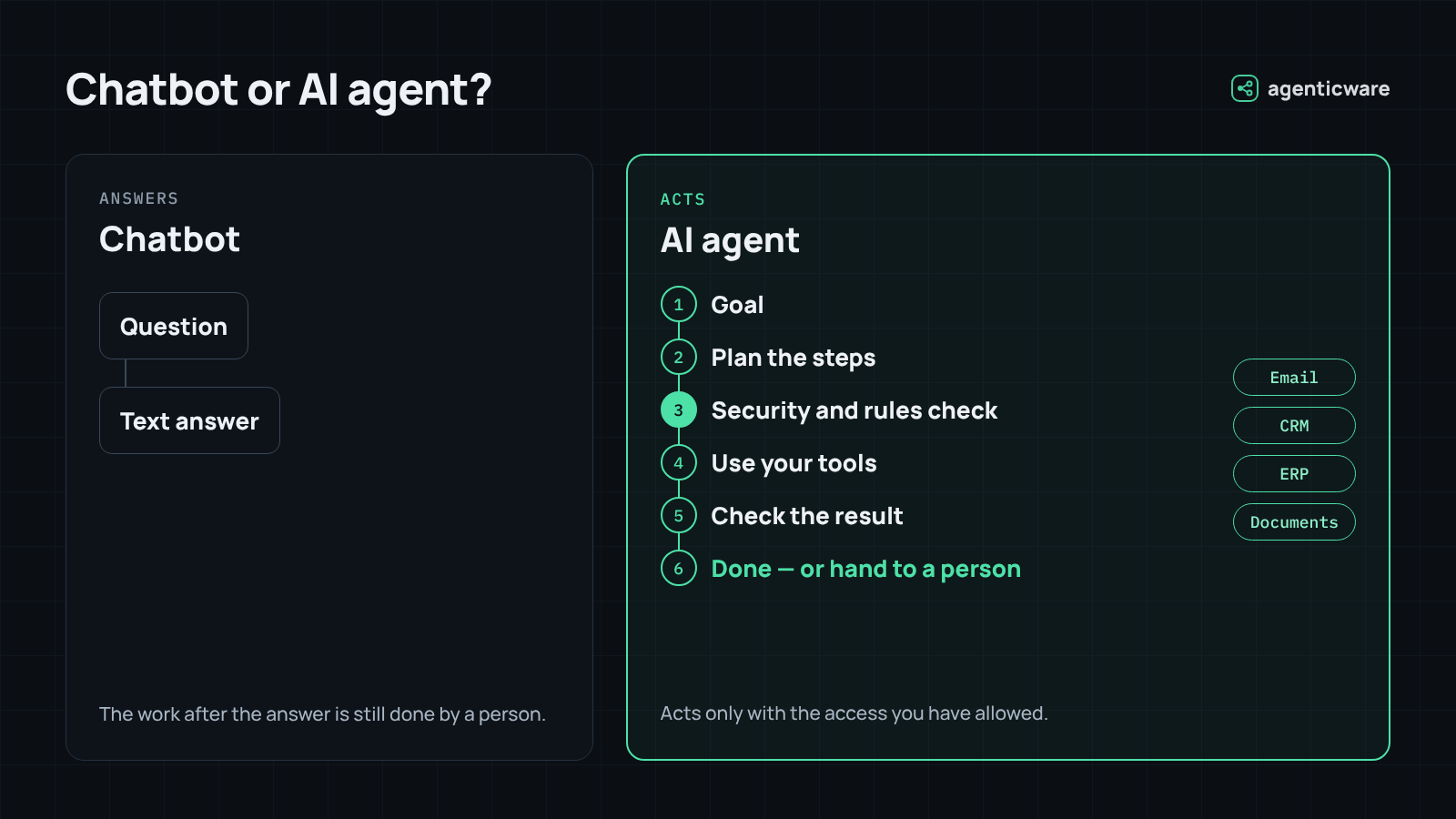
A chatbot waits for you to ask something and replies with text. A good one understands the question well and gives a clear, useful answer. But the conversation is where its work ends. If a customer asks “Where is my order?”, a typical chatbot can explain how to track a delivery. It cannot look up that order, see that it is delayed and tell the customer the new date.
That is fine for many situations: frequently asked questions, opening hours, simple product information. The limit is that a person still has to do everything that follows the answer.
An AI agent completes tasks
An AI agent starts from a goal, not just a question. It works out the steps needed to reach the goal and carries them out using the tools you give it: your email, CRM, accounting software, documents or calendar. Typically, an agent:
- Understands the goal, for example “reply to this customer about their order”.
- Plans the steps: find the order, check its status, check stock or delivery, prepare a reply.
- Passes a security and rules check before acting: each step is checked against permissions and rules set in advance, such as which data it may use, which actions are allowed and which need approval. We design these rules with GDPR and the EU AI Act in mind. If a step falls outside them, the agent stops and asks a person.
- Uses your tools to do those steps, only with the access you have allowed.
- Checks the result, for example tone, prices or required approvals.
- Finishes the task or hands it over to a person when something is unusual, sensitive or outside its rules.
Think of it as a digital colleague with a clearly defined job. It does not get tired of repetitive work, and it does not need to be reminded.
The same request, handled two ways
Imagine a customer emails: “I ordered 20 boxes of paper last Tuesday. When will they arrive? Can you add 5 more?”
With a chatbot on your website, the customer would get a general answer about delivery times and be asked to contact the sales team. An employee then reads the email, opens the order system, checks the stock, updates the order and writes back.
With an AI agent, the email arrives and the agent:
- finds the order in your system and sees it is scheduled for Thursday;
- checks that 5 more boxes are in stock;
- prepares a reply with the delivery date and a proposal to add the boxes to the same delivery;
- logs the request in the CRM;
- because changing an order affects the invoice, sends the draft to an employee to approve with one click.
The employee only checks and approves instead of doing the whole task, and the customer gets an answer much sooner.
What an AI agent is not
There are a few common misunderstandings worth clearing up:
- It is not unlimited. An agent can only use the systems and actions you allow. If it has no access to payments, it cannot make payments.
- It does not replace your team’s judgement. It removes the repetitive work around decisions, so people can focus on the decisions themselves.
- It is not perfect. Like a new colleague, it can make mistakes. That is why a well-built agent works with clear rules, checks and a person who approves sensitive steps.
- It is not a big IT project. A first agent usually starts with one well-defined task and is extended only after it proves useful.
How you stay in control
Control is designed in from the start, not added later:
- Permissions: the agent gets access only to the data and actions its task needs, nothing more.
- Approvals: for anything sensitive, such as changing an order, sending an offer or deleting data, a person confirms first.
- Logs: every action is recorded, so you can see what the agent did and why.
- Escalation: unusual or emotional cases go straight to a person.
- Data protection and compliance: we design the agent with GDPR in mind, and people are told when they are dealing with AI, as the EU AI Act requires. You can read more in Is AI safe for my company’s data? and on our Regulations page.
When is a chatbot enough, and when do you need an agent?
A chatbot is usually enough when:
- people ask the same general questions again and again;
- the answer does not depend on data in your systems;
- nothing needs to happen after the answer.
An AI agent makes sense when:
- the answer depends on your data, such as orders, invoices, contracts or stock;
- after the answer, someone has to do something in a system;
- the same kind of task takes your team hours every week.
How to start
The best first agent is not the most impressive one, but the one that removes a task your team repeats every day. Good candidates are answering standard customer emails, entering invoices and orders, and following up on enquiries. For ideas, see 5 tasks an AI agent can take over in your company this month.
At Agenticware we start with a free AI audit: a short conversation about how your team works, and a concrete list of tasks worth automating. Then we build the first agent, connect it securely to your systems and test it on real work before it goes live. See our services for details.
Frequently asked questions
Is ChatGPT an AI agent?
On its own, ChatGPT is mainly a chat assistant: it answers and writes. Some versions can now take actions, but they do not know your company’s systems, data and rules. A business AI agent is set up for one specific job and connected only to the tools that job needs.
Does an agent need access to all our systems?
No. It gets access only to what its task requires. An agent that answers order questions needs to read orders. It does not need access to your accounting or HR files.
What happens if the agent makes a mistake?
Sensitive steps are approved by a person, every action is logged, and the rules are adjusted when something goes wrong. The aim is to catch mistakes before they reach a customer, and to learn from the ones that do.
Do we need technical staff to use an agent?
No. Your team works with the agent through tools they already use, such as email, Teams or your CRM. We take care of setup, security and maintenance.
Nikolay Kalchev
Nikolay Kalchev is CEO of Velox Ltd, the IT infrastructure and security company behind Agenticware. Learn more about Velox →