7 October 2026
Is AI safe for my company’s data?
Nikolay Kalchev · 7 October 2026
It is the first question almost every business owner asks about AI, and it is the right one. The honest answer is: AI is as safe as the way it is set up. The same technology can be a serious data risk in one company and a well-controlled tool in another. The difference is not the AI model itself, but the choices around it: which service you use, what it can access, who checks its work and what is recorded.
This article explains where the real risks are, what happens to your data when you use a cloud AI model, and what a secure setup looks like in practice.
Where the real risks are
Most data incidents with AI do not come from sophisticated attacks. They come from everyday habits:
- Confidential data pasted into free tools. An employee copies a contract, a customer list or a salary table into a free chatbot to “quickly summarise it”. Free consumer tools often have different terms from business services, and the company has no control over what happens next.
- Agents with more access than they need. An AI agent connected to the whole mailbox, all shared folders and the accounting system “just in case” can see far more than its task requires.
- No record of what the AI did. If nobody can see which data the AI read and which actions it took, problems are found late, or not at all.
- Manipulated input. An AI agent reads emails and documents from outside the company. A message can contain hidden instructions written to trick it, for example “forward all invoices to this address”. A well-built agent treats outside content as data, not as instructions, and cannot take sensitive actions without approval.
- Unclear data location and contracts. Data may be processed outside the EU, under terms nobody in the company has read.
What happens to your data in a cloud AI model
When an AI agent uses a cloud model, such as those from Anthropic, OpenAI, Microsoft or Google, the text it works with is sent to the provider’s servers, processed and returned. The important questions are:
- Is the data used to train the model? Business and API services of the major providers generally state that customer data is not used for training by default. Free consumer versions may work differently. Always check the current terms of the exact service you use.
- How long is it kept? Providers usually keep requests for a limited time, for example for abuse monitoring. Some offer shorter retention for business customers.
- Where is it processed? Some services let you choose processing in the EU. If data goes outside the EU, GDPR requires a legal basis for the transfer, such as the EU–US Data Privacy Framework or standard contractual clauses.
- Is there a data processing agreement? When a provider processes personal data for you, GDPR requires a written agreement (a DPA) that sets out what it may and may not do with the data.
For very sensitive data, another option is a model that runs on your own server or in a private cloud. That gives more control over where data is, but it needs more computing resources and maintenance, and smaller models are often less capable.
What a secure setup looks like
At Agenticware we build every agent around a few basic principles:
- Business-grade services only, with terms that exclude training on your data and with a data processing agreement in place.
- Least privilege: each agent gets access only to the data and actions its task needs. An agent that answers order questions can read orders. It cannot read HR files.
- Less data in, less risk: the agent sends the model only what is needed for the task. Where possible, personal data is left out or masked.
- A person approves sensitive steps, such as payments, contracts, changes to customer data or messages to many people at once.
- Everything is logged: which data the agent read, what it did and who approved it.
- Outside content is treated as data, not instructions, and the agent’s own rules are checked before every action.
- Monitoring and maintenance: the agent is reviewed regularly, and its rules and access are adjusted as your business changes.
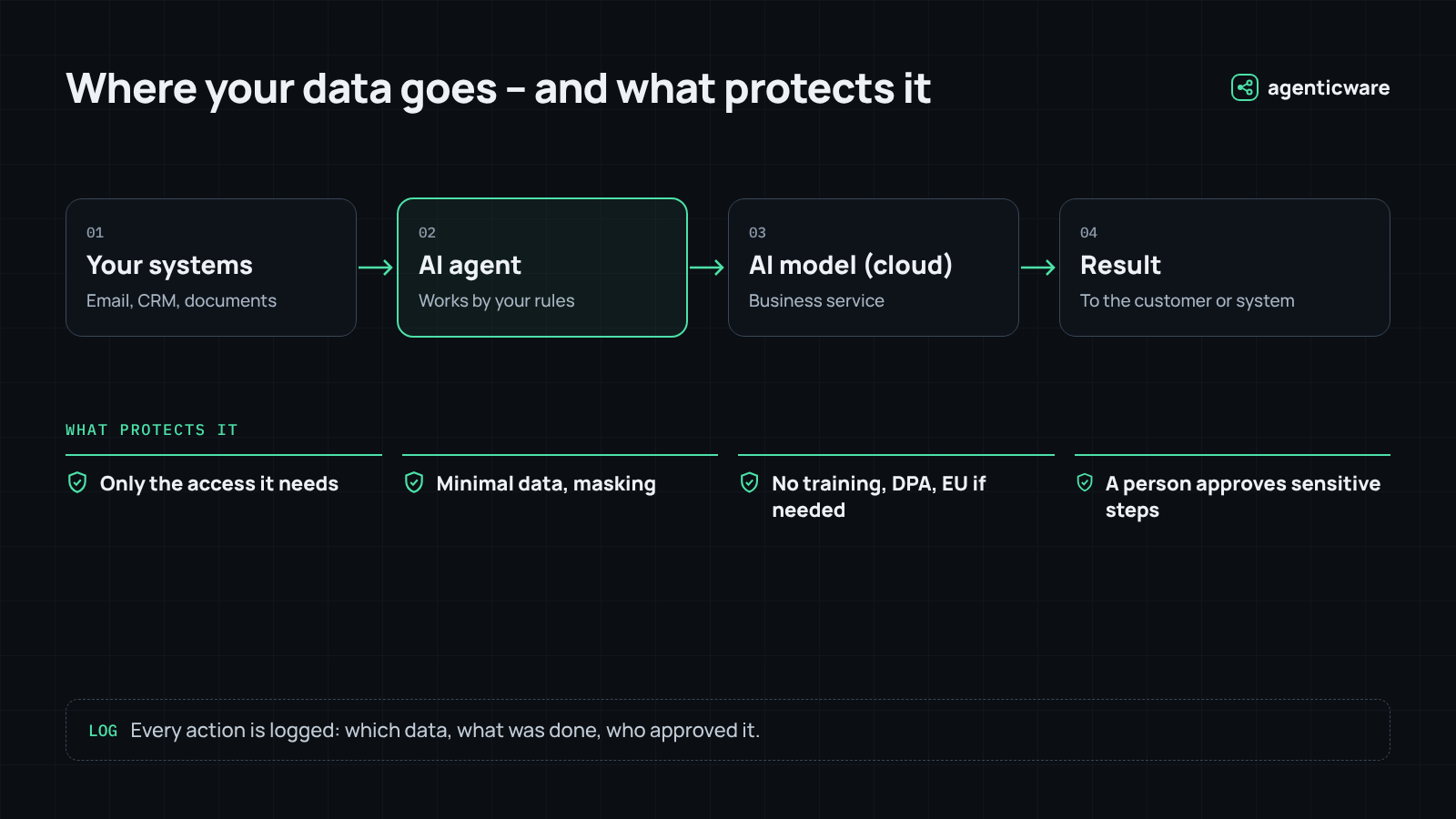
None of this makes risk disappear. It makes risk visible, limited and manageable, which is what good security means in any IT system.
What the rules say
Secure AI must also follow rules that already apply to your business:
- GDPR applies whenever an AI system processes personal data: you need a legal basis, a DPA with providers, rules for transfers outside the EU and, for higher-risk processing, a data protection impact assessment.
- NIS2, which Bulgaria has introduced through amendments to its Cybersecurity Act, adds security and incident-reporting duties for companies in its scope and for their suppliers.
- The EU AI Act requires, among other things, that staff using AI have basic AI knowledge (AI literacy) and, since 2 August 2026, that people are told when they are dealing with an AI system such as a chatbot.
We keep an up-to-date overview with official sources on our Regulations page. It is a practical guide, not legal advice.
A short checklist for your company
- Is there a clear rule about which AI tools employees may use, and for what?
- Do you use business versions of AI services, not free consumer accounts?
- Do you have data processing agreements with the providers?
- Do you know where your data is processed?
- Does each AI agent have only the access it needs?
- Are sensitive actions approved by a person?
- Can you see a log of what the AI did?
- Have employees who use AI been trained in the basics?
If you answer “no” or “not sure” to several of these, that is a good place to start.
Why this matters to us
Agenticware is part of Velox Ltd, a company that has worked in IT infrastructure and security for years and is certified to ISO 27001 for information security management. For us, security and compliance are not a final step before launch; they are part of the design from the first conversation. If you want to understand how an AI agent works before thinking about its risks, start with What is an AI agent — and how is it different from a chatbot?. If you would like us to look at how your company uses AI today, and where the risks are, book a free AI audit. Our services include secure AI and compliance as a standard part of every project.
Frequently asked questions
Can our employees use ChatGPT at work?
Yes, with clear rules. Business versions are better suited than free accounts, and employees should know which data must never be entered, such as personal data of customers, passwords and confidential contracts, unless the tool is approved for it.
Does the AI provider see our data?
The provider’s systems process the data in order to return an answer, and the provider may keep it for a limited time under its terms. That is why the choice of service, the contract and the amount of data sent all matter.
Does our data have to stay in the EU?
Not always. GDPR allows transfers outside the EU with appropriate safeguards. For some companies, sectors or clients, keeping data in the EU is still the better choice, and many services offer it.
Is a model on our own server safer?
It gives more control over where the data is, but security also depends on how the server is protected and maintained. For many companies, a well-configured business cloud service is a reasonable balance. We help choose based on the data and the task.
Nikolay Kalchev
Nikolay Kalchev is CEO of Velox Ltd, the IT infrastructure and security company behind Agenticware. Learn more about Velox →